
Key Highlights
- Play-based learning encourages natural curiosity and cognitive development.
- Everyday toys serve as tangible tools for understanding basic math concepts like counting and geometry.
- Simple play activities naturally introduce scientific principles such as gravity, cause and effect, and structural integrity.
- A play-based preschool in Singapore provides a structured environment for children to experiment and solve problems independently.
Introduction
Early childhood education is a dynamic field that constantly evolves to better support the developmental needs of young children. As parents and educators look for the most effective ways to nurture potential, the focus has shifted towards active, hands-on experiences. A well-designed preschool curriculum in Singapore recognises that children learn best when they are actively engaged with their environment. One of the most powerful strategies to facilitate this is the use of everyday toys as educational instruments. By integrating these simple objects into daily learning, educators can introduce complex concepts in math and science in ways that are accessible and enjoyable.
The Foundation of Play-Based Learning
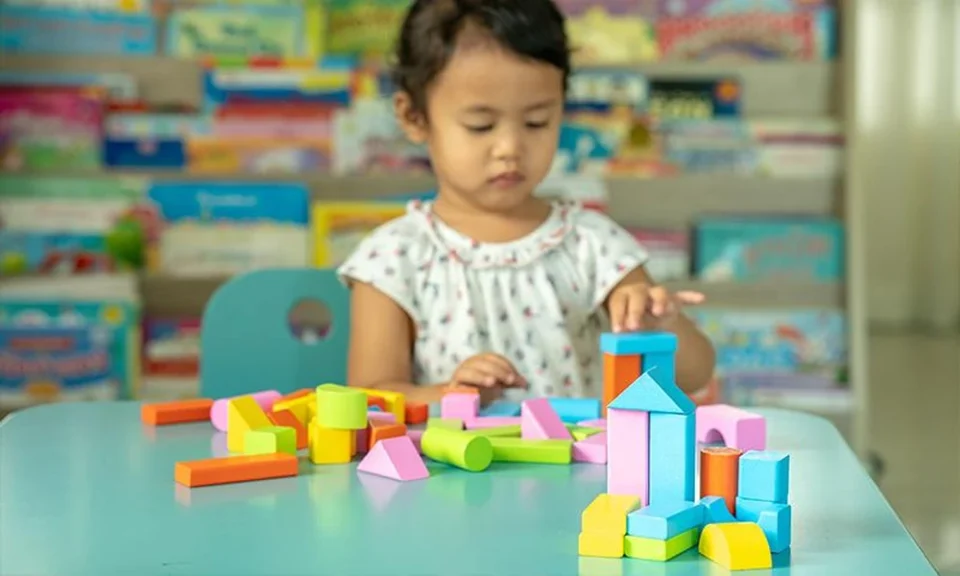
The philosophy behind a play-based preschool in Singapore centres on the belief that children construct knowledge through interaction. Unlike traditional rote learning, where information is transmitted passively, this method allows children to manipulate their world. When a child plays with building blocks, they are not just stacking wooden shapes. They are investigating balance, symmetry, and gravity. These interactions form the building blocks of early scientific inquiry and mathematical logic. By leveraging toys that children are already familiar with, educators remove the anxiety that can sometimes be associated with academic subjects, allowing children to focus entirely on the process of discovery.
Toys as Tools for Mathematical Logic
Math is often perceived as an abstract subject, but for a preschooler, it is grounded in the physical reality of their surroundings. Everyday toys are exceptional tools for teaching counting, sorting, and measurement. For example, sorting toys by colour, size, or shape helps children develop early skills in data categorisation and pattern recognition. When children use counters or small figurines to solve problems, they are physically acting out arithmetic operations.
In a play-based preschool in Singapore, teachers facilitate this learning by asking open-ended questions that encourage children to predict and test their theories. If a child is tasked with sharing blocks equally among their peers, they are introduced to the concepts of division and fairness. Similarly, using a ruler or tape measure to compare the length of toy cars provides a practical introduction to standard and non-standard units of measurement. These activities transform math from a series of equations into a series of rewarding puzzles.
Exploring Science Through Hands-On Discovery
Science in the early years is synonymous with curiosity. It is about understanding how the world works through observation and experimentation. Everyday toys provide the perfect laboratory for these experiences. A simple toy car rolling down a ramp illustrates the principles of friction and velocity. Toys that float or sink in a water tray introduce children to the concepts of density and buoyancy.
Furthermore, a comprehensive preschool curriculum in Singapore ensures that these activities are guided rather than left to chance. Educators observe the play and provide subtle scaffolds-such as offering a different material to see if a ramp works better-that deepen the scientific thinking. This process of hypothesis and testing fosters an attitude of inquiry. When a child tries to build a tower that will not topple, they are engaging with structural engineering. When they explore the texture of different items in a mystery box, they are classifying materials based on physical properties. Each of these moments is a foundational scientific experience.
Building Resilience and Social Skills
While the academic benefits are significant, the social and emotional advantages of this approach are equally important. Solving a problem with a toy requires patience, collaboration, and the ability to handle frustration when things do not go as planned. In a play-based preschool in Singapore, children learn to negotiate with peers, share resources, and communicate their ideas. These soft skills are essential for lifelong success, regardless of the academic path they follow in the future. By creating an environment where curiosity is valued and failure is viewed as part of the experiment, educators build confident learners who are not afraid to ask questions.
Conclusion
The integration of math and science into early education through toys is a highly effective way to prepare children for the challenges of primary school and beyond. By choosing a programme that prioritises these hands-on experiences, parents can ensure their children develop a positive relationship with learning from an early age. Whether through counting beads or testing the strength of a bridge made from blocks, children are developing the cognitive framework necessary for deeper understanding later in life.
At Little Seeds Preschool, we are dedicated to fostering holistic growth through meaningful play. If you would like to learn more about our approach to early childhood education and how we prepare your child for a bright future, we invite you to speak with us. Contact Little Seeds Preschool today to schedule a visit and see our curriculum in action.
